
Join our class today and get a special price!

A boxed course · Ships across the worldwide

The Chinese Calligraphy Master Class Kit

A complete studio in a box, and twenty hours of recorded instruction to go with it. Open it, set up your desk, and write your first stroke.

INSTRUCTION
20 20 Hours
STRUCTURE
10 Models
ACCESS
Lifetime
LEVEL
0 Beginner
LANGUAGE
Your Choice

What arrives

Everything on this list is in the box. You will not need to buy a single thing.

Most people who want to try calligraphy stall at the same place: a shopping list they can’t evaluate. Which brush? What kind of paper? Is this ink any good? The wrong first brush will make you think you have no aptitude, when in fact you just have a bad brush.

So I chose everything myself, from the same suppliers I use for the Warsaw, Poland offline workshops, and packed it in the order you’ll need it.

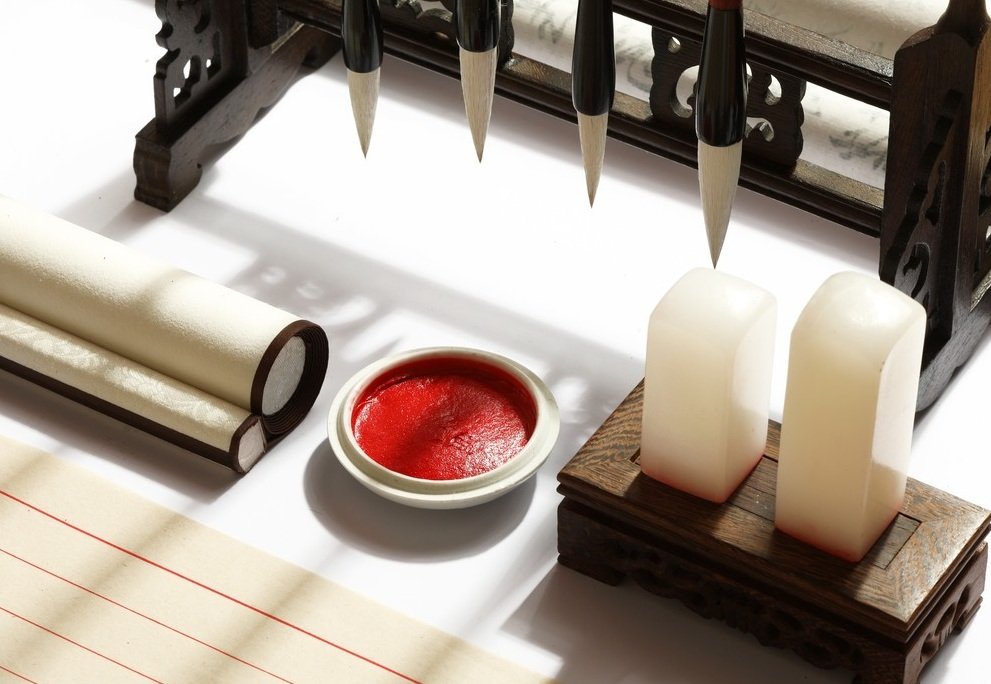
15 pieces set Inside: two handmade brushes, a porcelain desk set (Ink dish, brush rest, brush pot, and water dropper), a handmade ink stick and premium inkstone, wool felt mat, paperweights, handmade Xuan paper — 34 × 138 cm, 50 sheets, a water-writing cloth, a printed workbook, your mounting kit, e-book: Clerical Script: The Cao Quan Stele

Two handmade brushes
Premiu handmade - material is 70% goat hair, 20% weasel, soft enough to be expressive, springy enough to be precise, and steady across every character size and every major script. These are the same brushes I hand to every new student in the studio.

Wool felt mat, 97 × 38 cm
Double-layered and water-resistant, so ink never reaches your table. The edges are bound by hand — it will outlast the course by years. Rolls up when you're done.

Handmade Xuan paper — 34 × 138 cm, 50 sheets
Real handmade rice paper, in the tall format calligraphy was made for. Enough for one to three months of regular practice.

A water-writing cloth
Write with plain water, watch it fade, write again. Practise at any hour without opening the ink or cleaning anything.

A porcelain desk set
Ink dish, brush rest, brush pot and water dropper, in traditional Chinese porcelain. Not decoration — the dish controls how much ink the brush carries, the rest keeps a wet brush off your table, the dropper lets you add water a few drops at a time while grinding. Together they make a desk you'll want to sit down at.

Clerical Script: The Cao Quan Stele
My own e-book for beginners, built around one of the most beautiful surviving stele inscriptions — written for people coming to this from outside the culture, not from inside it.

Liquid ink, a handmade ink stick, and a stone inkstone
Two ways to work. The bottled ink is for practice, when you want to start writing within a minute of sitting down. The stick and the stone are for the days you have time: you grind your own ink, choose its density, and the five minutes it takes are the oldest part of the whole tradition. Most kits skip this. It's the part people end up loving.

The study notes (PDF)
The same guide I use in my weekly classes: stroke structure, brush technique, the mistakes beginners actually make and what to do about each one, and a practice method tested on real students. In English or Polish — or name your language at checkout.

Paperweight
Holds the sheet flat and still while you write.

Your mounting kit
A hanging scroll and a folding fan. In the final module you mount your own finished work on both — one for the wall, one to keep or give away.

The lessons

Twenty hours, in ten modules

Lessons run five to twenty minutes each, so you can do one before dinner. The order matters: each module rests on the hand you built in the one before it.

01 Where this comes from

Three thousand years in ninety minutes: from marks scratched on ox bone to an art form judged like music. Why a culture decided that handwriting could be the highest of the arts — and what it means to say a stroke reveals the state of the hand that made it.

1h 

02 The five scripts

Seal, clerical, regular, running, cursive — how to tell them apart on sight, what each was for, and how one grew out of the last. By the end you can walk into a museum and read the room.

1h

03 The Four Treasures

Brush, ink, paper, inkstone — what each one does and how to judge it. Setting up your space, cutting the Xuan paper down to working sheets, and washing a brush so it survives you.

1h

04 Holding the brush, moving the brush

The five-finger grip, the upright wrist, and the centred tip. Starting, travelling, stopping. Pressure and lift. Long control exercises on the water cloth, where mistakes cost nothing and disappear in a minute.

1h

05 Meeting the Cao Quan Stele

A stone carved in 185 CE, buried for fourteen centuries, and still the gentlest teacher clerical script has. What makes it beautiful — the wide stance, the silkworm head, the swallow’s tail — and why it is the right first model for a beginner.

1h

06 The strokes of clerical script

Every stroke in the script, one at a time, in the Cao Quan manner: the rising horizontal with its flared exit, the level vertical, the sweep, the wave, the dot. Overhead, at quarter speed, then yours.

1h 30m

07 Character by character — I

Your first characters from the stele itself. Clerical structure is unusually forgiving: broad, level, symmetrical. Each character comes with its meaning and its sound, so you always know what you’re writing.

4h 

08 Character by character — II

Compound characters — left and right, above and below, enclosed. How the parts share space, and how the eye decides a character is balanced before the mind knows why.

4h 

09 Character by character — III

The traditional method: you don’t invent your own forms yet, you assemble a phrase from characters the master already wrote. We’ll work from a prepared set — classical couplets, well-wishes, and a few short Tang poems — and lay them out in columns.

3h 

10 Your own work

Choosing your phrase, writing the final version, signing it, and mounting it — once on the hanging scroll, once on the folding fan.

2h 30m

Plus two written companions: my e-book on the Cao Quan Stele, and the study notes I use in my weekly classes — covering stroke analysis, brush techniques, common beginner mistakes, and a proven practice method. Available in English, Polish, or other languages upon request.
How it works

Four steps, and none of them involve a schedule

Order

The box ships within five working days, across the worldwide

Open

Scan the card inside, and the whole course unlocks. No account juggling, no waiting for a cohort.

Practise

Thirty to sixty minutes, three times a week, is the pace that works. Most people finish in about ten weeks. Some take a year. Both are fine.

Mount

Module ten walks you through finishing your work on a scroll or a fan. You finish your own artworks.

Thirty minutes, three times a week, beats two hours on a Sunday. Every time.

Calligraphy is not information you receive. It is something your hand learns slowly, between sessions, in short repetitions — which is exactly why a recorded course suits it better than most subjects. You cannot rush the hand, and you shouldn’t have to keep up with anyone else’s calendar while you’re waiting for it.

Lifetime access means you can stop for four months and pick it up again without losing anything. Plenty of people do.

Order

Three versions

450 EUR

/ Package

COURSE ONLY

digital, nothing shipped

What's included?

*Terms and Conditions apply

680 EUR

/ Package

MASTER CLASS KIT

 kit and shipping included

What's included?

*Terms and Conditions apply

830 EUR

/ Package

PREMIUM PACKAGE

 kit and shipping included

What's included?

*Terms and Conditions apply

Need a custom pricing plan?

As a gift

It is a very good thing to receive in the post

The box is designed to be opened by someone who wasn’t expecting it. Ink, brushes, paper, a stone seal, and a course that starts the same evening.

  • Gift note handwritten in ink, in English or Polish, at no charge
  • Send it directly to them, or to yourself to give in person
  • Recipient chooses their own scroll or fan when they activate

About the Instructor

I’m a creative producer who has lived in Poland for six years, and the person on the other side of the camera for all twenty hours.

I started learning calligraphy in the regular script when I was seven. Those lessons were strict, repetitive and occasionally miserable, and they remain the most profound artistic influence of my life. What I understood only much later is that the discipline was never really about the characters. It was about attention.

Two years ago a friend asked me how to hold a brush. That question became a workshop, and the workshop became a room in Warsaw that fills up every month. This box exists because of everyone who then wrote to ask whether they could do it from Berlin, from Lisbon, from Kraków, from a village in Wales — and because a room in Warsaw only holds six people at a time.

FAQs

Frequently Asked Questions

No, and nothing in the course assumes it. Every character we copy comes with its meaning, its sound, and the reason it looks the way it does — you're never tracing a shape blindly.

You'll finish able to write around thirty characters properly and to build a phrase from them. That is a different thing from knowing many characters badly, and in calligraphy it is the more useful of the two.

Yes. Calligraphy is a physical skill, closer to learning an instrument than to drawing. It rewards regular repetition far more than natural ability — and complete beginners often move faster than people arriving with strong drawing habits to unlearn.

Three things. The tools are already correct, so you never wonder whether the problem is you or the brush. The order is deliberate — twenty hours built as one sequence, not sixty unrelated clips. And a third of the course is diagnosis: not just how a stroke should look, but how to see what's wrong with yours and fix it.

Yes. Every kit includes one work review — send a photograph whenever you're ready and I'll write back with specific corrections. Extra reviews can be added at checkout or bought later. And you can always just email me.

Because one script learned properly is worth five scripts sampled. Module two gives you all five — enough to recognise them, place them in time, and read a museum wall. Then we spend the rest of the course inside clerical script, which is the kindest of the five to a beginner: broad, level, symmetrical, and slow enough that your hand can keep up with your intention.

The model is the Cao Quan Stele, carved in 185 CE. Two thousand years of Chinese students have started here. Once you have it, the other scripts are a smaller step than you'd think.

Please do. The onsite weekly practice workshop runs weekly and kit owners get a reduced rate — bring your own brush and you'll already know how to hold it.

Fifty sheets of Xuan paper covers roughly one to three months of regular practice — the full course, with room to repeat the hard modules. The water-writing cloth takes the daily load off the paper. When you do run out, there's a refill pack, and the course tells you exactly what to buy if you'd rather source it locally.

Select your currency
PLN Polish złoty
EUR Euro